Supply Chain Planning & Digital Transformation
Let Data Do
the Dirty Work.
Modern supply chains need more than spreadsheets and yesterday’s assumptions. Connected operational data makes it possible to explore scenarios, anticipate exceptions and focus on the decisions that matter.
The opportunity
From collecting data to using data.
ERP, MES, WMS, TMS and other operational applications already hold valuable information about demand, production, inventory, transport and customer behaviour.
The challenge is rarely a shortage of data. It is the time spent collecting, reconciling and interpreting disconnected information.
A better division of work
Let systems do the repetitive work.
Connect trusted sources to create a shared picture of the supply chain. Give planners the information and analytical tools to investigate trade-offs, rather than asking them to maintain yet another spreadsheet.
Why planning must evolve
Planning has changed.
Historical performance and human experience remain important. But rapid changes in demand, capacity, supplier availability and transportation require planners to evaluate alternative actions much faster.
01 / DEMAND
Market volatility
Demand changes faster than fixed forecasts can capture.
02 / CAPACITY
Production constraints
Capacity and material limitations influence what is feasible.
03 / NETWORK
Supply disruption
Supplier and transport conditions change operational options.
04 / TRADE-OFFS
Business impact
Cost, service and working capital must be considered together.
The connected planning model
From operational data to better decisions.
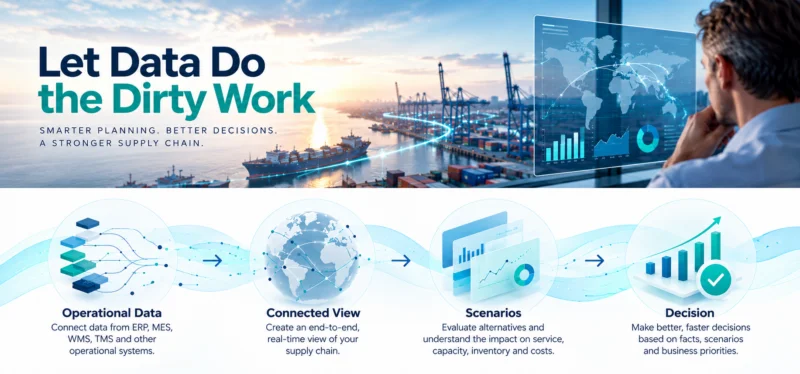
A practical planning model connects four elements: operational data, a consistent view of the supply chain, alternative scenarios and informed decisions.
STEP 01
Connect operational data
Bring orders, production, inventory and transport information together from ERP, MES, WMS and TMS.
STEP 02
Create a connected view
Understand suppliers, sites, warehouses, products and customers as one interconnected network.
STEP 03
Evaluate scenarios
Compare credible “what-if” options before committing scarce capacity, stock or resources.
STEP 04
Make better decisions
Use timely insights to balance operational realities with service, cost and strategic priorities.
Scenario planning
Explore the options before choosing a direction.
Data-driven planning becomes valuable when teams can see the consequences of their choices. Consider a sudden increase in customer demand:
Assess additional production shifts, available materials and capacity bottlenecks.
Explore alternative sites, suppliers, inventory positions and transportation routes.
Understand the implications of allocating constrained supply to priority orders.
Decision intelligence
Analytics informs. People decide.
The goal is not an automated decision without context. The goal is to give experienced planners a clearer, faster way to understand implications and choose an appropriate response.
A wider management perspective
From planning to Integrated Business Planning.
Traditional Sales & Operations Planning aligns demand and supply. Integrated Business Planning goes further, connecting operational scenarios with the financial and strategic consequences of each choice.
The result is a more constructive discussion between operations, supply chain, commercial teams and finance.
One decision. Multiple perspectives.
Choose options based on their overall business implications, not an isolated functional KPI.
Where the value appears
Let technology handle the repetitive work.
A connected planning environment can monitor changes continuously, highlight exceptions and make the next useful action easier to identify.
- Automatic exception detection
- Dynamic planning parameters
- Demand and capacity scenarios
- Inventory and service optimisation
- Supplier and transport performance insights
- Faster cross-functional collaboration
- Operational and financial comparisons
- More time for high-value planning work
Data shows what is happening.
Analytics helps explore what could happen.
Experienced people decide what should happen.
The business outcome
From data to business value.
The objective is not to collect more information. It is to create a faster, more transparent and more reliable decision process: connect operational reality, explore credible alternatives and let teams focus on the decisions that move the business forward.
Technology brings consistency and analytical speed. People contribute context, experience and accountability. Together, they make supply chain planning more adaptable and useful.
MERLYN CONSULT · SUPPLY CHAIN ADVISORY
Make better supply chain decisions.
Discover how connected data, smarter planning and independent expertise can improve your supply chain performance.